
Episode 10: Interview with Simon Heseltine
Today’s interview partner is Simon Heseltine, Director of Audience Development for AOL. He and his team work with all the AOL sites like Huffington Post, TechCrunch, Engadget or AOL Autos.
This interview is also available on iTunes and on Youtube.
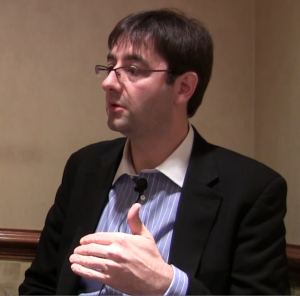
Simon Heseltine
Follow OMReport on Facebook, Twitter or as to get the newest interviews fast.
Transcript
When Andre visited New York in March to attend the SES conference, he also did some interesting video interviews for his OMReport. Those videos will be published during the forthcoming weeks on omreport.com. In the first edition of this series we spoke with Simon Heseltine. Simon is the Director for Organic Audience Development for AOL. In this function he works for sites like The Huffington Post, Engadget or TechCrunch:
Andre Alpar: Hello Simon. Nice to meet you. Can you introduce yourself really quickly?
Simon Heseltine: Sure, I’m Simon Heseltine. I am the Director of organic audience development for AOL, which means I work with all types of brands.
Andre Alpar: It’s a unique title –
Simon Heseltine: Well, we’re actually within the audience development organization, which is part of the CAO’s organization – the Chief Analytics Officer. So we are a cross-functional team. We work with every site within AOL whether it’s TechCrunch, Huffington Post, Engadget, AOL Autos… everything across – the whole ganap.
Andre Alpar: So you are like a task force being sent to where the fire is lighting up the most?
Simon Heseltine: In some cases. We work with our teams in a variety of different ways. It can be proactive, it can be reactive. When it’s proactive, we are going out there and looking for ways that we can improve our sites. Ways that we can figure out how to improve whatever the team is doing. Whether it’s training the actual individual team members or whether it’s finding a white space where that product could particularly be in. So we’ll go out and do that.
On the reactive side – you know – Google makes one or two changes every year. Or Google makes one or two changes every day. With some of those impactors, we have to look at ways to either react to that or figure out what we should be doing and how we should work with that.
Andre Alpar: So most of the businesses that you work on, they are classical publishing businesses. You earn enough ads. So there are no transactions per se. Or let’s say in most cases of the traffic that you talk of.
Simon Heseltine: The majority of our sites that my team works with are content based. We do have other sites that actually have products.
Andre Alpar: So how big is your team if I might ask in between?
Simon Heseltine: My team is one in two halves.
Andre Alpar: One in two halves. So you are one and they are the other half?
Simon Heseltine: Yes, I’m the one. I have one person on my team who does SEO and newsletters and I have one person on my team who is part-time.
Andre Alpar: So in general, the tasks that you have, are they more technical? Because as far as I know publishing businesses, most of them suffer with the, let’s say, technical part of things rather than acquiring links or these kinds of things because the publications that you work for, they have a gigantic numbers of links anyway. And the content, I mean that’s their core so they don’t need content per se. So I would assume most of your tasks would be rather technical or is it more like educating editors and that kind of stuff. Or tech guys?
Simon Heseltine: Well, it’s pretty much what you are saying there. I mean, we have spent probably a little bit more time on the technical aspect of things and we’re moving more into the training side now. I mean, we’ve always done training but we’re actually re-looking at our training and we’re really trying to formulize that a little bit more.
Now on the technical side, everyone comes out and says ‘content is king’. And content IS king and content is great, you need to have that, to have really good content out there to get your audience engaged, to get your audience involved, to get your audience coming back. However, if your audience can’t find that content what does it matter how good it is?
Andre Alpar: So it’s much about organizing the content, that’s the kind of task that you have to deal with?
Simon Heseltine: Well I would say it’s more about getting the architectural structure of your sites correct, making sure that there are no spider stoppers. Making sure that what you want to be crawled and found by the search engines can be crawled and found. That it’s organized in a good way, that you’re doing all the basics right, you’ve got the fundamentals right. And then you’re moving beyond that: You’re adding in authors, you’re adding in the schema.org information, all those little add-ons, that can help you to rise up the rankings, help you to be found and, as the old adage about the theatre is, ‘get the bums on the seats’.
Andre Alpar: So two questions. One is directly from what you said: How do you deal with authors that are not with the publications anymore that you are responsible for when they go? What happens with the author-tags that they have? Because I’d assume that their author profiles earn trust and visibility through working for the publications that you represent and then they move on. What happens then? Is there something like a standard process or are there two or three different cases that can happen?
Simon Heseltine: If we talk about the author profiles as shown in the SERPs, which comes from your Google+ account. I mean, your Google+ account is yours. It’s not an organizationally owned thing. It’s a personal thing. So when somebody moves on, they are still going to be associated with those articles that they wrote for us. When you look at the Huffington Post, we’ve had over a hundred thousand different writers. I mean, I’ve written one article, I should write more for them. But that’s linked to my Google+ profile and the article that I wrote is always going to be linked to that profile.
Simon Heseltine: But you wrote for us, it’s associated with it. We’re not gonna take your author profile off it. That byline is yours. The byline always stays with the article.
Andre Alpar: Because whatever the author does afterwards also pays in in the article that he wrote for, for example for the Huffington post.
Simon Heseltine: I mean, it could give more visibility to the prior articles and it’s another funnel potentially because you do have that ability to say, “Okay here’s what they also wrote”, so absolutely.
Andre Alpar: Ok, so what qualifies a person to be the SEO of AOL? …which okay I missed the title sorry-
Simon Heseltine: -I’m gonna call it audience development-
Andre Alpar: -well that sounds a lot more nicer than SEO.
Simon Heseltine: Well I mean, the title was SEO up until recently.
Andre Alpar: Is it because you also do the newsletters. That’s why it’s ‘organic’?
Simon Heseltine: Well, we are moving social within my team as well.
Andre Alpar: Ok, that makes sense.

Simon Heseltine
Simon Heseltine: And as we are in the audience development team, it makes it a little bit more formulized now. I started out as a software developer back in the day, working on Smalltalk and Java. And I worked for a publishing company – well, we worked with different yellow page sites. We worked with four of the top six at the time, taking their yellow pages and putting them on CD. So they could actually do print reduction. So rather than having to put all of these pallets of phone books out to a company, they could send one CD and put in on the intranet.
The next evolution was, naturally, to put it online. Once we put it online it was, “Ok, how do we get people to come look at it? Simon, why don’t you take a look at this SEO-thing?” So that’s how I first got involved in it. I moved it over as I worked in SEO in that company. And then after I’ve been with that company for seven years, I thought why not try something different? And I went to an agency. And I worked with that agency for a couple of years and I came to the realization that I want ownership of a project. I make these recommendations to companies and then they go away and I never know whether they do them of what the numbers are when they are done with it.
I want that ownership. I want the ability to say “Hey, I did this. This is the impact that I made.”
AOL had a position that was open. I came in and I worked with their sports team, with their news team and I’ve been there almost four years now. Now I’m heading up the team and it’s been a really interesting and fun ride. I think we’re in a position now… I mean, AOL as a company has made a huge turnaround within the last few years. I think we’ve got a great deal of upsides and a lot of opportunities, so I’m really excited about where we’re going.
Andre Alpar: Is it sometimes hard – as in – you are like an Inhouse-SEO – well part of you is that… How do you get people to buy in when you say “OK, I have this great project. I think we should put canonicals and noindex and this and this and this here.” And then there is a tech guy saying “it’s gonna cost this many hours or days of work. What is it going to bring us?” Especially when you get to these technical things, do you need to argue these kinds of things or – are you like the enlightened one and everyone listens to you?
Simon Heseltine: Well I think one of the first things you have to do, when you come into an organization, is to get those wins in that you can get. I hate that trade phrase like ‘the low hanging fruit’ but look for the hanging fruit! Look for those immediate changes that can move the needle in some way! If you work with multiple brands and the bigger brands don’t want to listen, go to the smaller brands, use them as a proof of concept. Come back to the bigger brands and say “Hey, we did this over here. They saw a 20 percent lift. We can do the same for you”. And I think that is a way of doing it.
In some cases, I mean you’re going to encounter resistance and it’s going to be difficult unless you have executive support.
Andre Alpar: So how is it in your case? Do you have executive support?
Simon Heseltine: Oh absolutely we do, yes. My team is directed to the CAO, the chief analytics officer and from him down and in fact from the CEO down. I mean, this audience development team, we ‘ve got a lot of executive buy-in. And across the organization we ‘ve done a lot of training with the different teams. We’re building it from the top down and we’re also building it from the bottom up as we’re working with the different teams. We’re doing training for developers, for writers, for editors. We’re doing training for lots of different roles within the organization. We kind of customize it for them.
Within an organization like ours, not every team is organized the same way. There are some that have product managers, there are some where development runs product. Some, where editorial runs product. So we have to basically work with those teams in a way they are structured and find the best way.
Andre Alpar: So you are a little bit like a consultant that first analyses who owns the product and who do you have to convince to get on my ship.
Simon Heseltine: Yeah, we are an internal consulting agency, is what we are.
Andre Alpar: It’s like the best of both worlds a little bit.
Simon Heseltine: Yeah. But we have that ownership. We are the ones that when something works really well, we actually hand out a trophy every month for the team that does the best with their audience development metrics. Not just SEO, not just social, but also the paid side, paid social and all of the different things that we look at.
Andre Alpar: Ok that’s a pretty good tool to communicate the success of the different teams. So how many different teams have you worked with so far over the years?
Simon Heseltine: Oh gosh, lots. Back when I started with AOL I believe the count was 135 different brands We‘ve done a lot of consolidation over time. And I think when you look on our corporate site now we’re around 40 brands that we are listing there – 40 to 45 I think. Some of them are smaller brands. There is not necessarily an upside to them. I mean AOL artists is a really cool site where we are working with different artists, to put together logos for AOL basically. And if you are aware of what our logo is, our logo is basically anything behind the words AOL. So we have these artists that generate these really cool graphics for us that we actually throw on the AOL homepage. And I love taking them and throwing them into my presentations but it’s a site that’s not going to generate ten million clicks a month.
Andre Alpar: It’s a niche topic.
Simon Heseltine: It is: But we consult with them every now and again, we give them a little piece of advice here and there when they need it. But obviously the bigger brands, where there is more of an upside. You know, we work for the Huffington Post –
Andre Alpar: – Sorry, with the Huffington post, you mentioned that there is like a hundred thousand people who have wrote for them at one point in time. But they are not present at one place. So how do you think of teaching them? Do you go into distance teaching, or will you fly them all in to a conference where you coach them?
Simon Heseltine: The Huffington Post, they have actually had a really good training program before they became a part of AOL.
Andre Alpar: Like an internal one?
Simon Heseltine: Yes, internal. Every week they do trainings. So anybody who comes on new, they have to go through these different trainings. So they realized upfront, because of the way they are, they need to make sure they formulize and make people know what is ‘The Huffington Post way’. So they‘ve been doing that. But a lot of these people are bloggers as well, they just write on average one or two blog-posts a year. So, we get a lot of celebrities, a lot of politicians. David Cameron, the Prime Minister of Great Britain, he has blogged for us. I’m pretty sure – that we haven’t had him go through formulized training. I’m pretty sure, he just put the blog-post together, sent it over, we put it up.
We’ve had Barrack Obama, before he was the president. There are a couple of blog posts that he has done.
Andre Alpar: Amazing, so you don’t ever think about links, do you?
Simon Heseltine: Oh, we do.
Andre Alpar: It’s more about an internal distribution rather than an acquisition when it comes to new links. I mean, when you have that what do you need?
Simon Heseltine: I would not say that we have necessarily a formulized link building program outside of the organization. But we look at some brands and look at how we can maybe improve their link profiles. But we definitely don’t go out there and do any of the no-no stuff, any of the link buying.
Andre Alpar: It’s not necessary.
Simon Heseltine: It’s not necessary and to be quiet frank, I don’t want any of my sites to get hit like that. You know, I’ve seen people who have gone out there and tried some of this stuff – and yeah, some of this stuff has worked in the past. But you want to be really careful. Especially when you are working with big brands, you can’t afford something to go wrong.
Andre Alpar: Sure, everybody looks at them so if they misbehave, the probability that it’s going to show up is much higher.
Simon Heseltine: Yeah, I mean we’ve seen the overstock, we’ve seen J.C Penny, we’ve seen Interflora … I don’t want to add one of my brands to that. I don’t want to be made an example.
Andre Alpar: Thanks so much for the interview Simon.
Simon Heseltine: Sure, absolutely, thank-you!
This interview is also available on iTunes.
More interviews of this series will be published.